
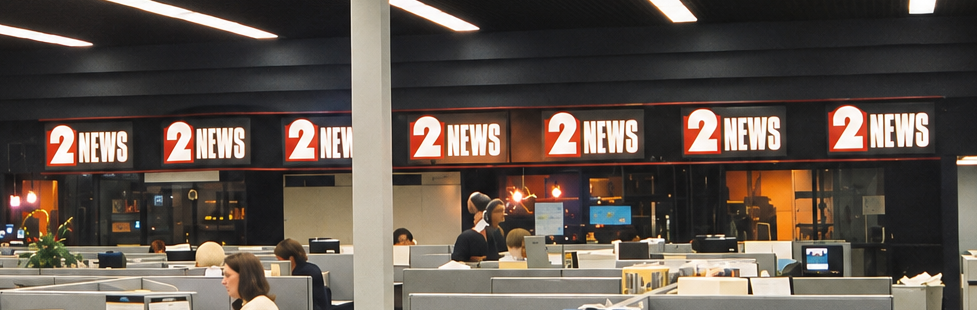
In the summer of 1992, I was an intern with the political unit at WBBM-TV, Channel 2 in Chicago, and I wrote a summary of each week. Six weeks of those pages survived. Read today, they are less a record of what I learned than a picture of how a big-market newsroom ran when everything was tape, phones, and people.
I had three years of college in Ithaca behind me. My assignment was the station’s political reporter, Mike Flannery, and his producer. The producer usually stayed in the office working the phones, and I went out with the reporter and a crew.

630 North McClurg Court
CBS bought the old Chicago Arena in Streeterville in 1954 and had the arena’s original architect redesign it as a broadcast center. When it opened in 1956, WBBM Radio took the upper floors and Channel 2 took the ground floor, with four studios down one long hallway.

The building had history before I walked in. On September 26, 1960, Studio 1 hosted the first televised presidential debate, between John F. Kennedy and Richard Nixon. Studio 2 was home to the 10 o’clock news. Over the years the same hallway produced Donahue and Siskel & Ebert.

In 1992, none of that felt like history. It was where the political unit had its cramped office, where the unit kept its own shelves of tape in a back room, and where edit rooms lined the hall. As a non-union intern I wasn’t allowed to touch the tape decks, so when a tape needed to come out of a deck, I yelled across the hall for someone to eject it. Rank had its own hardware too. The assistant news director could shut his office door with a button on his desk when he wanted privacy.

The Assignment Desk Before Software
The first place they put an intern was the news desk. My description of it in week one is the whole job in one sentence: people “monitor other TV stations, police scanners, schedule what units go out on shots, take in coming calls, and call people about news stories.”
There was no screen that showed where the crews were. The desk knew because the desk had sent them. I remember a clipboard for the crews and a whiteboard for the stories. Competition was watched on a wall of monitors, and breaking news came in over scanners and the phone.
There was no GPS and no online map either. The desk kept a Chicago street guide close at hand, and the city’s grid did the rest. Chicago’s street grid is built around State and Madison, with roughly 800 address numbers to the mile, so 4800 West is about six miles west of State Street. A tip with an address became a location, and the desk could work out which crew was closest and how to get them there.
Much of the news came from calling around. The desk made regular beat checks, calling police districts and other agencies on a schedule to ask whether anything had happened since the last call. The desk was surrounded by reference books and phone lists for the city’s police stations, hospitals and government offices. But the most valuable book was often someone’s own contact book. One of my intern jobs was copying a worn-out contact book, page by page, into a new one. Every number in it was a story someone could get on the phone.
Some of the best videos came in through phone tips. On June 14 the Bulls won their second straight championship, and that night stores on the West Side were looted and burned. The next morning the desk phones filled with people who had shot it on home video, and my job was screening the calls. Two hours later, one caller arrived with a tape showing someone taking an axe to a store door and people running out with food and clothes. It was used more than any other tape in that night’s newscast. The station paid $100 to $150 a tape. It took hours to get it on the air. Today the same video would be on someone’s social media feed in seconds, and local news is often not the first to show it.
The anchors read from prompters, but the newscast still ran on paper. Another intern job was ripping scripts. The newsroom printer turned out every script as a stack of color-coded copies, and before air someone had to tear the sets apart and get each copy to the right person: one for each anchor and one for the director. Every color set had to be ready before the news, and if a script changed late, it was printed and ripped all over again.

Into the Field
WBBM’s field crews shot on Sony Betacam, a professional videotape format at the time. My notes record how the staff explained the change: everything was now Beta because it was “smaller, lighter, and have better quality.” By then the station’s crews had moved on from the older three-quarter-inch tape.
Most of the photographers I rode with were Vietnam veterans, and by 1992 they were the senior people in the shop. They drove in Ford Crown Victorias fitted with spotlights, two-way radios and car phones built into the dash to stay in touch with the station.


The Archive
In my first week the staff told me a story about why the station’s older archive had holes. As I heard it, in the late 1960s WBBM feared it could lose its license over an FCC inquiry into a story about a marijuana party at Northwestern. According to the story, film and tape from the late sixties and early seventies were thrown out, including coverage of the 1968 Democratic Convention. A few were supposedly rescued from the trash by staff, and no one knew where they went.
The station’s main archive was on the top floor of McClurg Court, in a dark room lined with rows of shelves holding film cans and tapes. The CBS News bureau was nearby. I spent time walking those rows trying to find out whether the story was true. I never could. The irony is that by my fourth week I was cleaning out the political unit’s own back-room shelves, and I threw out about fifty tapes myself.
Thirty-four years later, old newspaper pages confirmed the first half of the story. WBBM-TV aired a two-part report on November 1 and 2, 1967, called “Pot Party at a University,” showing Northwestern students smoking marijuana. Congress and the FCC then investigated whether the station had staged the party, and for most of a year WBBM’s license renewal was on hold. In May 1969 the FCC ruled 6–1 that the station had been wrong to broadcast a party its own producer had encouraged, but not wrong enough to lose its license. Whether the scare emptied any of those shelves, I still don’t know.


The Floor at Madison Square Garden
If the story was true, WBBM’s coverage of the 1968 Democratic Convention was among what went into the trash. Twenty-four years later, I wanted to be at one of those conventions. In mid-June I spent two days writing a memo to the reporter arguing that I should go. The answer, as I recall, was that interns didn’t go to conventions. That didn’t stop me. I paid my own way to New York, stayed with my brother and covered every expense myself, because I wanted the experience.
I shared a WBBM credential with my political reporter: Mike Flannery. Floor passes were limited, so the station had to decide who needed one at any given moment, and for some of those moments it was me.
It got me onto the floor the week Bill Clinton was nominated. I’d like to say I remember the feeds, the trucks and how the tape got back to Chicago, but I don’t. I was 21 and an intern, and interns run. I ran tapes, messages and errands, and went wherever I was told to go next.

What It Became
My weekly summaries record a newsroom where nearly every step ran through tape, phones and people. Almost every page describes work that technology would change over the next thirty years.
I didn’t know any of that in 1992. I was the intern yelling across the hall for someone to eject a tape. But two things from that summer stayed with me.
The first was the assignment desk. WBBM brought me back in 1993 as an assignment desk assistant. A year later I was an assignment editor at WGN-TV, Tribune’s Chicago station, and then at Tribune’s Washington bureau, in the chair where the scanners, the phones and the crews all came together. In 2017 I helped build Tribune’s own assignment desk system to track stories, crews and calls. The job it organized was the one I watched being done with phones and a wall of monitors in 1992.
The second was the archive. I never found out whether the shelves on the top floor of McClurg Court had been emptied, but I never stopped caring what happens to a station’s history once it’s sitting on a shelf. Today much of my work is helping stations preserve decades of recorded news in digital archives that can be searched and shared, so the next intern who goes looking can actually find it.

Chris Hutchins is a broadcast technology professional with more than thirty years of experience managing infrastructure across television station groups. He writes about the intersection of legacy broadcast operations and emerging AI tools. LinkedIn profile
Leave a Reply