
Why We Built It
Beginning in 2000, Tribune deployed Sony Newsbase across its television stations, and for years it was how Tribune newsrooms recorded and played video. By 2008 Sony had stopped developing it, and it never made the jump to HD. Sony’s next system, SonAPS, wasn’t HD yet either; its HD version wasn’t due until July 2008. So we had to start looking.

After Newsbase, we had to evaluate other systems. Broadcasters usually start with broadcast vendors, so Grass Valley was the first logical step. Grass Valley Aurora went into KCPQ in Seattle, Washington, KTXL in Sacramento, California, WGNO in New Orleans, Louisiana, and the Washington bureau. Not every money-saving choice saved money. An inexpensive storage system we paired with Aurora was one of those.

Then the Apple wave came, and everyone was talking about Final Cut. We started to move away from broadcast systems to Sienna, made by a company in England and built around Apple’s Final Cut Pro and Apple’s hardware. We bought it through a reseller in the United States. It felt almost home-grown, as if a small team had built it, and it probably had the best interface I have seen. We installed it at WXMI in Grand Rapids, Michigan, and KSWB in San Diego, California.

Apple’s own commitment was fading right after we installed Sienna. It had stopped exhibiting at NAB in 2008, and in late 2010 it announced the end of Xserve, its server hardware. I was surprised by how fast it happened. For broadcasters who had invested in Apple’s technology, it raised questions about the company’s long-term commitment to the broadcast market.

Replacing Newsbase at KTLA and WGN was already on our plan for 2008. In early 2008, new engineering leadership arrived with a different idea of how: stop shopping and build it. The strategy slide at that spring’s chief engineers meeting summed it up as “television on a radio budget.” Sienna had felt almost home-grown. Why not build it ourselves?
What it was made of
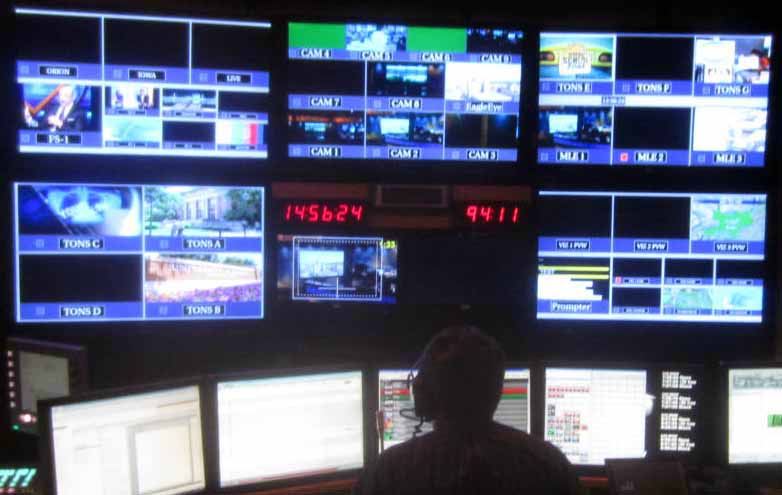
TONS was an HP desktop with a storage array. Playout was another HP desktop with an AJA card and a Sealevel card that listened for tally and GPI triggers.

The developers approached every hardware and software decision with cost in mind. They used as little memory as possible, avoided Windows Server licenses when they could, and reached for free software wherever it would do the job: Apache, MySQL and PHP for the system, FFmpeg for converting video and creating proxies. Storage was generic and cheap, and stations daisy-chained more of it as their libraries grew.
TONS was one piece of a larger shift. Along with a cheap HD playout system, the group brought in Sony’s EX cameras for the field and Apple’s Final Cut Pro for editing. The goal was to move stations off traditional broadcast equipment and onto tools built closer to the consumer market.

The industry was changing. For years we had bought broadcast hardware built to meet broadcast needs. Now we looked for consumer products that cost less and still met those needs, and more often than not they were just as good. Broadcast-grade systems had become too expensive for an industry that was losing its audience.
Broadcasters started going to CES, the consumer electronics show, as well as NAB.

Madison
The first time I saw TONS was in Madison, Wisconsin. We were there to visit Weather Central, the company that built weather graphics systems for TV stations, and I think the demo happened in the hotel lobby.
It was a website running on the developer’s laptop: a plain page in Internet Explorer, with Drupal, Apache, MySQL and PHP underneath and FFmpeg doing the video work. That was all of it.
Madison was also where I had been trained, years earlier at WGN in Chicago, on the DOS version of NewsStar. I had spent a long time since then with Newsbase, a full Sony broadcast system with racks of hardware behind it. Looking at that web page running on someone’s laptop, it was hard to imagine something so simple replacing something so complex.

A browser?
I was worried. We were building software that a newsroom would put on the air, and it ran in a web browser. I didn’t know if that would work.
What made it work sat underneath the page. TONS played video through the same engine as TOPS, the playout server we had proved in Fort Smith, Arkansas, two months earlier.

The players spoke VDCP, the control protocol most station equipment already understood, and they took it two ways at once. When an operator hit play in the TONS manual playout software, the command went over the network as VDCP over IP. When an automation system hit play, it often still came down a serial cable. Each player answered both at the same time, which let stations move to IP without unplugging what already worked. Playback could also run off tallies. When a source went to air, the tally went high and the clip played; if it ended while still on air, it froze on its last frame. When the tally went low, the clip ejected. Clips were fired from X-keys button pads, which gave us automated playback before the station had full production automation.

X-keys were another cheap answer. Traditional broadcast companies sold purpose-built hardware playout controllers. X-keys were programmable USB keypads sold to anyone who wanted extra buttons on a computer; as I remember it, hobbyists used them to run model train layouts. Now they ran TONS.
The browser turned out to be the point. Because TONS was a website, any station on the network could open another station’s TONS. That is where this story ends up.

Launch, October 2008
We didn’t trust it yet. At WXIN in Indianapolis, Indiana, in its building on Network Place, we put two TONS playout channels on the air and left two Newsbase channels running beside them. TONS had no record channels at launch, so every feed still came in through Newsbase.
We did the same at KTLA in Los Angeles, California, in January and February 2009 and at WGN in May. For the first seven months, the group’s two biggest stations ran TONS with Newsbase still plugged in beside it.
That was how most of our launches went. Nothing worked perfectly on day one, and the old system stayed connected until the new one earned the job.
One launch went the other way. In April 2010, the Avid system at WHO-TV in Des Moines, Iowa, failed, and we had to bring TONS up remotely. Because TONS was just a website for the newsroom and the editors, there was nothing to install at their desks, so we could launch it without being in the building.
That was the difference from the commercial systems of the time, which usually needed software installed on every workstation, mapped network drives, stacks of servers in the rack room, and configurations on each machine.

What it did in a newsroom
TONS did the jobs Newsbase had done, plus some Newsbase never did. By 2012, a station’s user guide described it this way:
- Search. A single search box, like Google, across the station’s video.
- Rundowns. TONS read the newsroom rundown over MOS, the standard newsroom systems used to talk to video servers. It was built first for ENPS and later worked with iNews.
- Recording. Scheduled and immediate recording of feeds, once record channels arrived. TONS switched the station’s router to the right source through Blackmagic’s control API.
- Playout. Four to eight playout channels per station, controlled from the rundown, by tally or by button. Clips in 1080i or 720p were converted automatically to the station’s playout format.
- Feeds out. Newsbase had a feed playback product; TONS had to replace it. Before FTP was common, stations sent video to networks over Vyvx, satellite or microwave. KTLA, for one, fed CNN in Los Angeles: pick a few clips, mark them as a playlist, roll them.
- Ingest and web. A transcode queue brought in network clips for Final Cut editors, and a web queue sent video to the station’s web publishing platform.

Some features came straight from a station’s problem. KTLA had a helicopter, and producers needed to pull a usable piece out of a long aerial recording fast. The answer was Clip Editor: mark in, mark out, send the clip to the ENPS rundown.

iNews took more work. WITI in Milwaukee, Wisconsin, ran iNews instead of ENPS, and there was no plugin we could drop into it. So we built a separate web page where producers created placeholders for TONS video. It wasn’t perfect, but it worked.

Stations wanted TONS to play their show opens, so it supported key and fill playout. Tally protect kept an open’s trailing audio from being cut off when the director switched to another source.

Bonded cellular devices in the field fed TONS too. Their video landed in watch folders and was converted automatically to MPEG-2 HD files for playout, with metadata tagged to show where it came from.

We also made TONS self-healing, and we let stations see what it was doing. On the server, windows showed the MOS connection, storage transfers, the proxy engines and the VDCP controller, so an engineer could spot a problem without calling anyone. We tried everything to make sure a station never had to call us.
Building it ourselves meant a station could ask for a feature and get it.
TONS Goes to the Web
The web team got its own version. Once TONS Lite existed, the newsroom version picked up a name of its own: TONS Heavy. It was the same code at two different web addresses, Heavy for newsroom production and Lite for the web producer. TONS Lite captured a newscast’s closed captioning, then sent the video, a thumbnail, an XML file and the caption file to the station’s web provider. The web producer could edit and adjust the caption text, and during sporting events could search the captions for the word “touchdown.”

Stations soon found other uses for it. Several built larger TONS Lite recorders to capture different versions of the newscast and keep them longer. KTLA wanted to keep recordings for years. WGN set up a TONS Lite just for sports, recording Cubs and Bears games to keep forever. TONS put no limit on recording length. A whole game, start to finish, was one file.

Other TONS Locations
Down the left side of every TONS page was a menu called Other TONS Locations. Click a station and you were browsing its video library from your own newsroom. Anything not embargoed, you could pull.

Network video was ingested into TONS automatically. When a clip from Fox or CNN arrived, it was embargoed automatically so it couldn’t be shared.

The example everyone used: on Oscar night, KTLA shot backstage in Los Angeles, and WGN in Chicago pulled the footage straight out of KTLA’s TONS. No satellite window, no tape, no phone call to book a feed.

Most stations would just sit and watch KTLA’s helicopter as it chased stories around the city. All they had to do was mark in, mark out and download.
That only works if everyone is on the same system, and within a few years almost everyone was. The stations that had tried Sienna and Aurora moved over too: WXMI in April 2009, KSWB and KCPQ in December 2009, and KTXL in January 2010. The last install was in Salt Lake City, Utah, in May 2012.
Between October 2008 and May 2012, TONS was installed 32 times across the station group, a period of just 43 months. In less than four years, systems the group had spent the previous four years installing were replaced, station by station, with software written in-house.

Where it started
TONS began as a plain web page in a Madison hotel lobby, and I doubted it the day I saw it. Four years later it had gone in 32 times, and a newsroom in Chicago could pull video from a newsroom in Los Angeles through a browser.
TONS handled the video. The rundowns still came from someone else’s newsroom system. The next chapter takes us to WXMI in Grand Rapids, where the team developed Opus, its own newsroom computer system. That story comes next.
Chris Hutchins is a broadcast technology professional with more than thirty years of experience managing infrastructure across television station groups. He writes about the intersection of legacy broadcast operations and emerging AI tools. LinkedIn profile
Leave a Reply