
The room at NAB
In April 2008, every chief engineer in the group, from the Tribune stations and some of the new Local TV stations, sat in one room in Las Vegas. I didn’t know it then, but it would be the last time all the chief engineers met at a company-sponsored NAB meeting. Within months, the company was in bankruptcy, and the group never gathered that way again.
It was the NAB Show, and the company had changed hands four months earlier. Sam Zell’s deal had taken Tribune private in December 2007. That same month, Tribune and Local TV LLC announced a shared management company to run their stations together.

It was two days of meetings and a presentation of more than 200 slides. It covered everything: digital transmission, studio builds, traffic, branding, satellites, networking, business continuity. One slide set the tone: “Television on a radio budget.” Another, deep in the deck, introduced a low-cost HD playout server. On a table sat an ordinary HP desktop with an AJA video card inside. It would play HD video and take commands like any broadcast server.
Then the chief engineers were asked to stand on their chairs if they wanted change. News directors were in the room too, and only a few of them stood. Engineers don’t usually like change, because change is disruptive.
The vendors we had relied on for years had changed, and a slide in the deck said it plainly: Sony’s Newsbase had seen no development in four years, and Avid had stopped work on its Deko graphics line. Even Apple had pulled out of the show that year. 2008 was a shift in the industry for everyone.

From Chicago to Fort Smith
My career had been in Chicago and Washington, DC. Tribune was a big-market company, built on stations in New York, Los Angeles and Chicago. New technology usually proved itself there first.
KFSM was different. It was a CBS affiliate in Fort Smith, Arkansas, and until 2007 it had belonged to The New York Times. That year Local TV LLC bought the Times’ station group, and the new shared management company put KFSM and its sister stations alongside Tribune’s TV stations. The Fort Smith–Fayetteville market sits near the bottom of the top 100.

This was my first trip into a small market. The way I understood it, that was the point. If a cheap HD server could survive in a small station with old automation and a small engineering staff, it could survive anywhere. If it worked in Arkansas, it would work in Chicago.
The library
KFSM did not look like a television station. It looked like a historic library: tall columns, a pediment, a stone base.

The building at 318 North 13th Street opened on January 1, 1908, as Fort Smith’s Carnegie library. The Fortnightly Club, a women’s literary group whose first president was Mary Parker, wife of Judge Isaac Parker, helped secure a $25,000 Carnegie grant for the building. Parker was the federal judge whose court made Fort Smith famous. The library stands on the lot where the Parkers’ house stood until a tornado destroyed it in 1898.

In the late 1960s, the library moved out and sold the building to the TV station, then known as KFSA. By the time I arrived, the building had been remade around television. A portico had been added to the front. The original arches were behind paneling, the mosaic tile floors under carpet, and the rotunda skylight under colored plastic lighting.

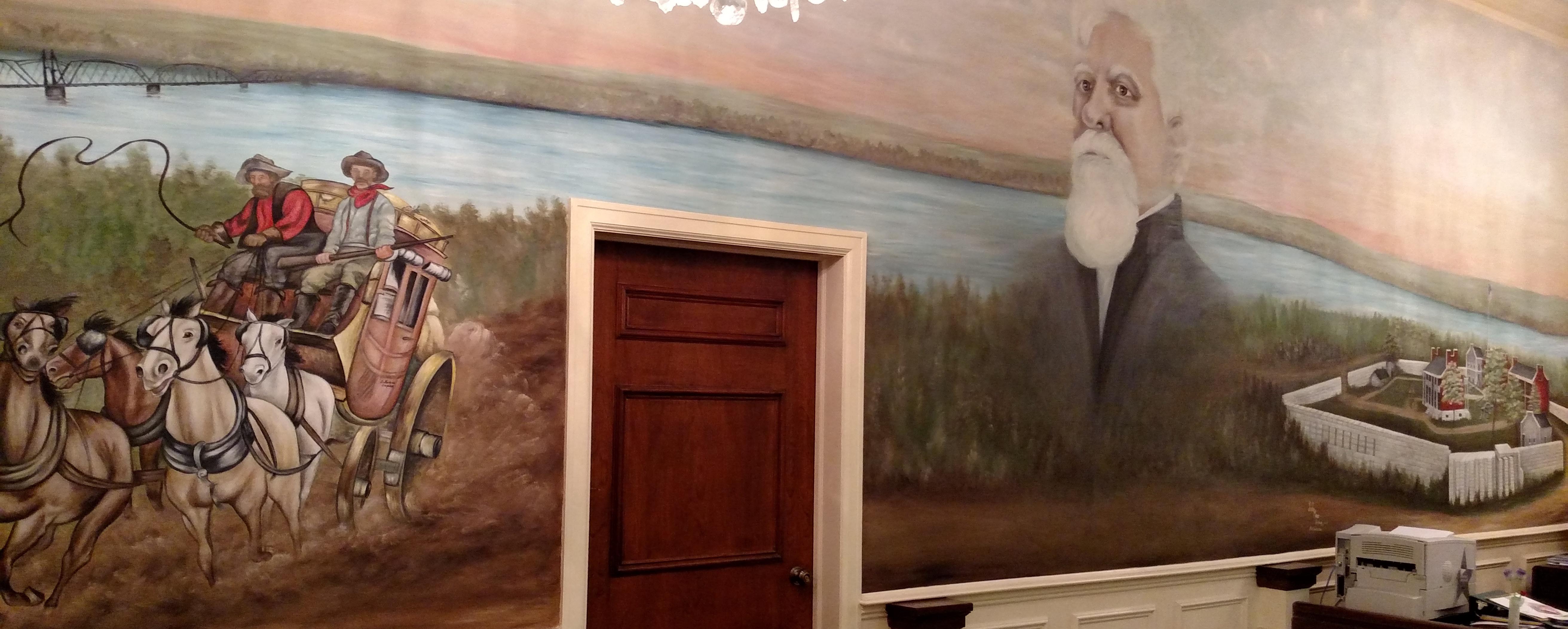
You entered into that rotunda. The reception desk sat in the center, about where a librarian’s desk might have stood. A double staircase climbed past a mural that wrapped the upper wall: a stagecoach on the Butterfield Overland Mail line, the Arkansas River and its bridge, the original fort that gave Fort Smith its name, and the face of Judge Isaac C. Parker.

Master control lived in the old library. The newsroom was next door, in a building that had been a medical office. Two buildings never meant for television, joined by cable.


What TOPS had to replace
The problem was HD. Syndicated shows were starting to arrive from the satellite in high definition. Wheel of Fortune and Jeopardy were already coming in HD, and word was that Dr. Phil would follow in early September. KFSM’s master control had been built for standard definition.

The station ran on automation inherited from its New York Times years. Its master control was already being run from a hub The New York Times had built at WTKR, more than 1,000 miles away in Norfolk, VA. Columbine JDS’s MCAS-III scheduled the programming and fired the commercials. A separate system called Orion recorded the satellite feeds. Another, MediaBase, was used to prep each show: find the start, mark the segments, set the times.

None of that was going away. TOPS had to fit in among it and take orders from all of it. What made that possible was a protocol. VDCP, the Video Disk Control Protocol, is a short list of serial commands: load a clip, cue it, play it, stop it, eject it. Most automation systems of the era could speak it, and most video servers could answer it. If TOPS spoke VDCP, MCAS, Orion, MediaBase and Florical could all drive it as if it were any other server. The commands ran over physical serial cables between the automation computers and the servers.

We installed three TOPS servers. One handled programming for master control, with three AJA cards: one to record the satellite feed in HD, one to play it to air in HD and SD, and one to feed the prep station. One served the newsroom under Florical control, playing news segments and commercials. A third, with four cards, handled news production and commercial playback. An Evertz HD router went in alongside.

What broke
The punch list from that first week reads like any first install. Automation told TOPS to play a 20-minute show, and it played 30 seconds. Captions, an FCC requirement, worked in HD but were missing from the standard-definition feed. One by one, the problems were fixed as new builds came in.

Wheel of Fortune
Tuesday morning, August 26, the network feed came down from the satellite. Orion recorded Wheel of Fortune in HD straight onto the new server under the house number WHD-0828, alongside Jeopardy.

At 11:03 a.m., I photographed the MCAS screen. In the noon-hour schedule on the on-air list was the line: CUE VHD1, WHEEL OF FORTUNE WHD-0828. VHD1 was TOPS.

Five minutes later the recorded show was up on a rack monitor beside the Harris and Dolby gear.
The server kept its own log. At 11:56:51 it recorded MCAS asking for clip WHD-0828, then cueing it 55 seconds in, for a segment 7 minutes, 23 seconds long, ready for its slot in the noon hour.

By Friday I was back at WGN in Chicago, testing Dolby audio on a Cubs game. Dolby was a running theme. TOPS had a checkbox in its record settings for Dolby E, the compressed surround sound networks sent to stations. It was there for WGN. The job was simply to pass the audio through untouched. As far as any of us could tell, the checkbox never did anything, but it made everyone feel better that it was there.

The rest of 2008
In October, a second product, TONS, launched at WXIN in Indianapolis. In December, TOPS cards went into the racks at WTKR, the same Norfolk hub that ran KFSM’s master control. That same month, Tribune filed for bankruptcy, eight months after the chairs at NAB.

Same software
In broadcasting, master control and the newsroom control room have traditionally been separate worlds. Different vendors, different servers, different people. One airs the network and the commercials. The other airs the news.
TOPS ignored that line from its first install. In Fort Smith, the same software played Wheel of Fortune for master control in the old library and played news segments for the newsroom in the old medical office next door. There was no master control version and no news version. To the server, a game show and a news package were the same thing: a clip to cue and play.

Afterward
In June 2019, KFSM moved its headquarters an hour north to a new building in Johnson. Northwest Arkansas, home to Walmart, Tyson and J.B. Hunt, had grown into the bigger half of the market, and the station followed its viewers. I was there that July to help move the station’s systems. When it was over, the racks in the old library stood empty, cables cut, consoles pulled. In 2024 the building was sold at auction, and its new owner has begun restoring it to the way it looked as a library.

Today’s gear talks over the network. VDCP, which once tied every server to every automation system, is now mostly overshadowed by network control. At NAB in 2026, I talked with one of the developers of Companion, the software that drives the Stream Deck control panels used across streaming and live production. I asked him if he knew VDCP. He said he’d never heard of it, and asked me to send him the details. That’s no knock on him. It shows how far the industry has moved.

TOPS proved itself in a Carnegie library. Its sibling, TONS, the system that would network every station’s video, launched two months later at WXIN in Indianapolis, in a new building in an office park, on a street called Network Place. That story is next.

Chris Hutchins is a broadcast technology professional with thirty years of experience managing infrastructure across television station groups. He writes about the intersection of legacy broadcast operations and emerging AI tools. All photos were taken by Chris Hutchins at Tribune television and newspaper locations over the years. LinkedIn profile
Leave a Reply